
Almond Learning — Decision Science and Risk Intelligence
Digital Literacy That Builds Resilience
Almond's Decision Science and Risk Intelligence (DSRI) is a K12 curriculum designed to help young people navigate digital systems safely and confidently.
The curriculum combines teacher-led group instruction with interactive, digital experiences, all underpinned by neuroscientific principles.
By using engaging, game-inspired simulations to demonstrate gambling-derived mechanics that are present in digital and real-world products increasingly targeted at young adults, Almond Learning teaches practical skills for online decision-making, financial choices, digital consent, and emotional regulation.
Why we created the DSRI curriculum
The Almond Health app was launched to help address the emerging public health crisis of rising gambling addiction in the United States. We continue to support people in forming healthy habits so that their enjoyment of gambling does not veer into a problem, as well as people who want to stop gambling because they feel it has become unhealthy for them, plus their loved ones.
As we worked, more and more we recognised that the early seeds of cognition that make some people susceptible to problem gambling start much earlier than adulthood. Our own users would report to us that they first gambled with money as young as 11 years old. Discussions with our clinical team highlighted that monetized and socialized reinforcement underpin the videogames and social media apps children and young people are adopting from a young age. When we dug further, we learned some concerning statistics:
- Before the age of 7, children in the US are already averaging 2 hours 27 minutes a day looking at screens, with 40% owning an ipad by age 2, and >75% using a mobile device daily.
- Aged 8-18, that daily screen use figure increases to 7.5 hours, with 80% using social media. 47% report being online "almost constantly", while 12% of teens reported gambling in the past year.
- And yet, only 32% of US schools teach gambling risk. Of those who are taught these risks, 75% report reduced intent to gamble.
Access to technology, use of social media and engaging with videogames are not negative things - they can be great ways to learn new skills and form healthy social relationships.
But the data tells us that as young people are exposed more and more to technologies that increasingly embed gambling mechanisms into their architecture, the risk of those young people developing a gambling problem increases, bringing with it financial and mental vulnerability.
It is certainly worthwhile educating young people about the potential risks of gambling and how to recognise a gambling problem, but this is not enough.
We need to empower them to recognize when a product or platform is making something seem urgent when it is not, and making something seem "winnable" when it is not.
This is exactly what the DSRI curriculum does.
16 lessons
Progressing through four units - mathematics, behaviors, product mechanics, and whole systems. Culminating in a Capstone lesson.
Designed for generalists
Full support materials guide teachers through the vocabulary, key concepts, anticipated student responses and differentiated support. No maths or psychology specialist knowledge required.
Integrated architecture
Fully integrated with Google Classroom, designed for easy integration with additional learning management systems as required.
Our Partners
Almond could not have developed this curriculum without the support and collaboration of experts from world renowned institutions




Unique multi-disciplinary collaboration
World-leading experts in cognitive neuroscience and developmental psychology, curriculum writers with decades of teaching and district management experience, and industry veterans with lived experience building modern reward systems such as gaming technology - this is the team that created Almond's DSRI curriculum from scratch.
This has produced a curriculum that naturally builds from mathematical concepts to behavioral impact and through to digital product mechanics, informed by deep understanding.
In this way, the curriculum provides students with fundamental understanding of how products work, and awareness of how their brain reacts.
Engaging experiences drive learning
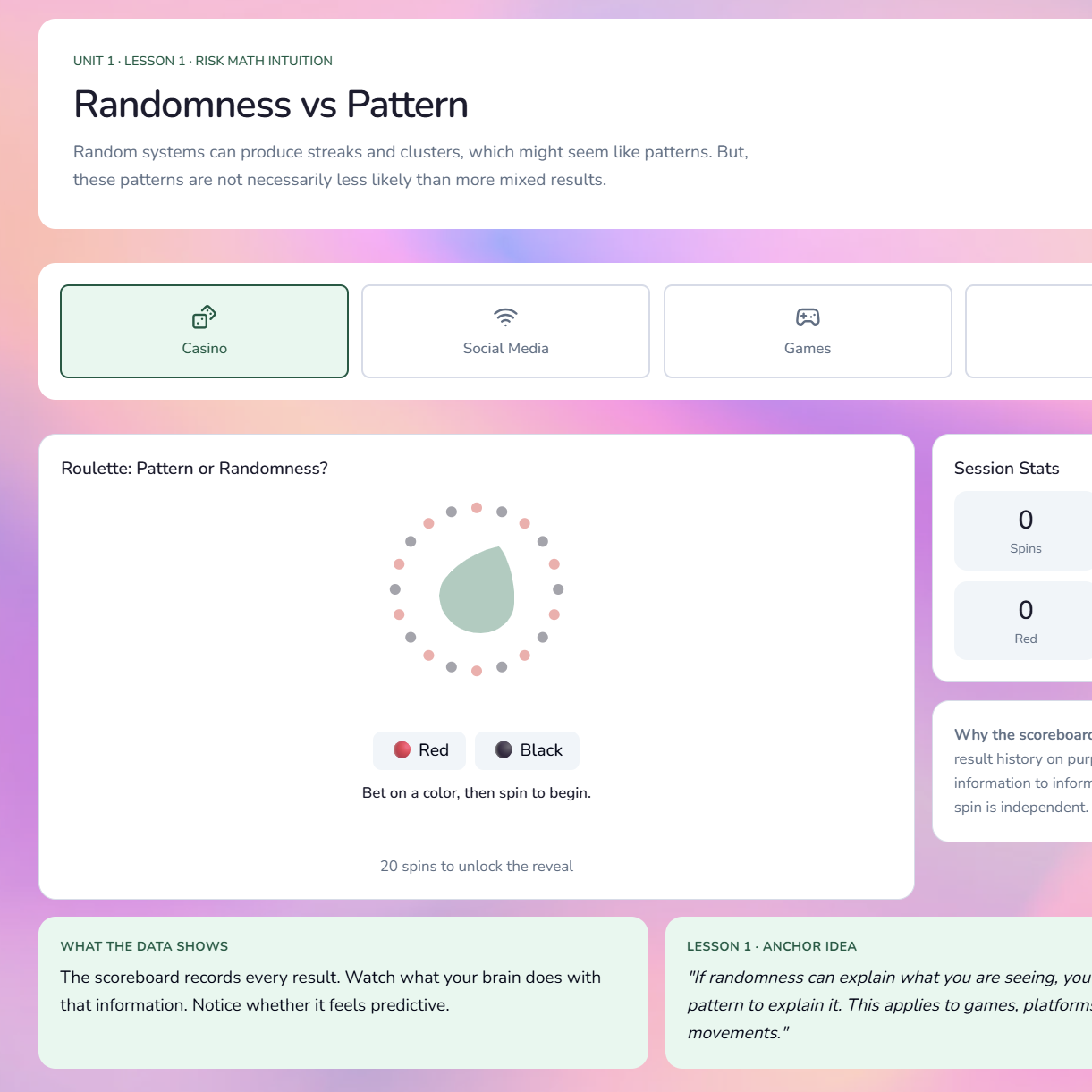
Every lesson combines educator-led discussion with solo learning through interactive simulations that demonstrate contextual examples of the learning.
Students have a safe space to experiment and observe for themselves how probabilistic concepts materialise, and how different outcomes affect them emotionally.
The mini-game feel of these interactive modules engages students fully and mimics the mechanics of the products they would encounter in real life, without the financial or psychological risk.
Working through the simulations gives students lived experience that solidifies learning. Regardless of the learning style of a student, the Almond curriculum will resonate.
Concepts applied across industries and products
The Almond curriculum was created from a recognition that the persuasive mechanics underpinning gambling technology are increasingly present in other digital products that children are exposed to from a young age.
Central to the curriculum is clear demonstration of how mathematical, psychological or product design elements from casinos, sports betting or prediction markets are also present "under the hood" of videogames, financial markets, social media algorithms and more.
Every simulated context allows students to see this in action, prompting reflection on how to recognise these elements in diverse products, and what this means for making informed choices about how to interact with them.